
A new look at old images
The animals
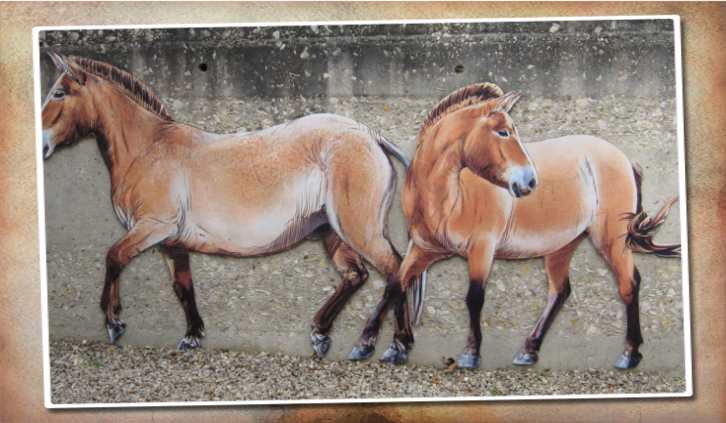
Painting on the wall of the
entrance gallery of the museum in Angles-sur-l'Anglin
(also: images of bison
and ibex)
Unfortunately, I forgot to note the name of the creator
of these beautiful
paintings.
Photos: Harald Ulrich
Horsesare the animals most frequently depicted in Ice Age art. Not because they were the preferred food and game, which was reindeer.The reason for the large number of horse images lies in the spiritual realm. In Ice Age imagery, horses symbolise the sun. (We also know this from Indo-European tradition.) The connection between horses and the sun is based on the observation that the gestation period of horses is about one year, a solar year. A horse therefore needs exactly as long to produce a new horse as the sun needs to bring about a new spring.It is easy to understand why the sun received special attention during Ice Age. Its significance for humans and in their world view is evident in the large number of horse images.
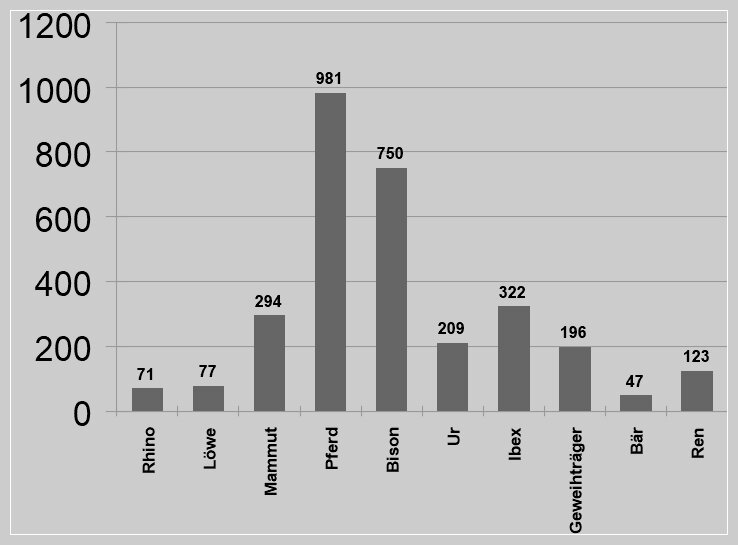
Data sources: Clottes & Lewis-Williams 1997; Sauvet/Wlodarczyk: Towards a formal Grammar of the European palaeolithic Cave Art, 2008
Bison
represent the moon in Ice Age rock paintings. The reason for this is easy to understand: it is the shape of the horns, which resemble the waxing and waning moon. We also know this from
Indo-European tradition. The chariot of the moon goddess is pulled by cattle, while the sun god's is pulled by horses. In keeping with the importance of the moon, bison images come in second place.
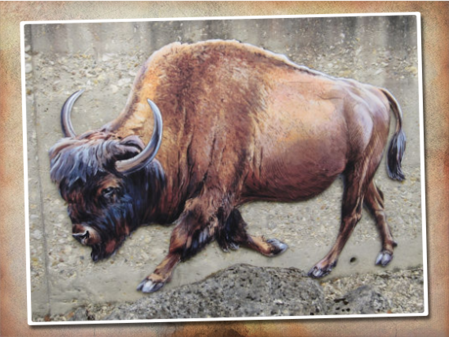
The aurochs, the original ox, underwent a very interesting development in cave paintings. First (Chauvet cave), black aurochs were painted as a visualisation of the new moon, with horns in the shape of the waxing moon. Later (Lascaux cave), the full moon was also depicted as an aurochs, in white colour with opposite horns.
If one adds up the images of bison and aurochs, the moon is only slightly behind the sun in the favour of Ice Age humans.
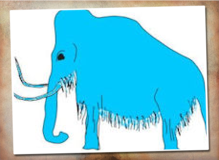
The mammoth
is the iconic animal of the Ice Age. (In particular, the rare subspecies 'mammuthus parvus caeruleus'). Its striking curved tusks make it a suitable moon animal. Its size may also have made it a symbol of the sky. But I'm
not sure about that yet.
The ibex
ranks third in popularity after horses and cattle.
The male animals have magnificent horns, which again brings to mind the moon. But no, our ancestors assigned the ibex a different task. It stands as a symbol of time for the winter solstice because these animals have their rutting season at exactly this time, thus renewing themselves like the sun.
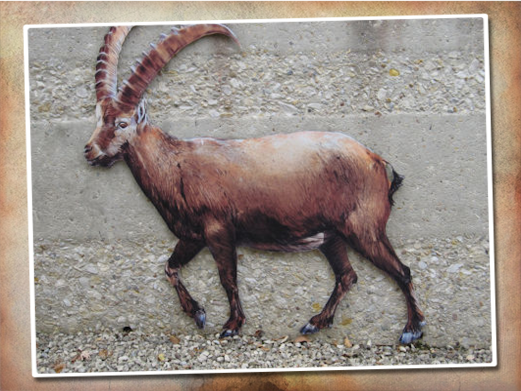
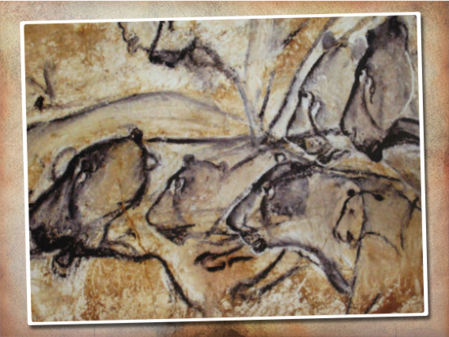
Photo: Harald Ulrich
Display at the 'Centre d'Interpretation
du Roc-aux-Sorciers'
in Angles-sur-l'Anglin
Lions
are rather rare in cave paintings. Chauvet is an exception, a veritable "cave of lionesses". I deliberately chose the feminine form, because the vast majority of this species painted in caves are lionesses.
The lioness is a manifestation of "Mother Earth". She stands at the beginning of everything, being the mother of the moon/moon animals and mother of the sun horses. She certainly also gave birth to humans, but I have not yet found an image of this.
More details on the function of the lioness and its derivation can be found in my book.