
The Moon
Ice Age people depicted celestial phenomena and the myths derived from them in their cave paintings.
Because the moon is the second most important celestial body after the sun, we find its symbolic animals bison and aurochs second most frequently on the cave walls, after the sun horses.
The moon is interesting because it changes shape periodically at short intervals: waxing moon, full moon, waning moon and no moon at all (called black moon or new moon). On the other hand, it is difficult to observe because it is sometimes visible at night, sometimes during the day; sometimes it rises at midday and then again in the middle of the night.
But the astronomically interested people of the Stone Age were persistent observers. They eventually discovered that the moon behaves in a similar way to the sun.
The moon's rising and setting points on the horizon move back and forth and there is a northern and a southern moon standstill. But while the sunrises take a year to move from the southern solstice to the northern summer solstice and back again, the moon manages this in one month. The lunistices therefore occur 24 times a year.
The moon also offers a particularly impressive spectacle: the northern lunistice at full moon in winter takes place even further north than the summer solstice.
It is therefore surprising only at first glance to find this drawing in the Lascaux cave:
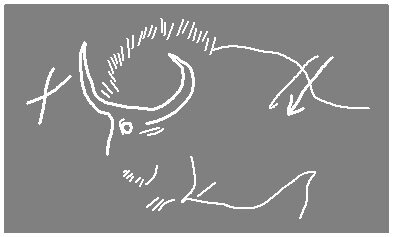
Drawing: H. Ulrich after photo by A. Leroi-Gourhan
The moon bison appears in a white colour, so it is a full moon. The horns, which are almost rounded into a circle with the eye in between, also indicate this phase of the moon.
The turning sign X (known from the sun) is engraved in front of the bison's head. It has therefore been generalised and here also stands for the turning of the moon. The "arrow signs" ⇂ ↓ on the animal's back provide more precise information: the northern turning point is depicted here. This engraving was carved into the wall at the very end of the Cabinet of Lions. It is the last depiction in this corridor, at the physical turning point. Place and representation, the reversal of man and the reversal of the lunar path, are thus related to each other.
This image from the Niaux cave, several millennia younger than Lascaux, is a little more difficult to read.
It was one of the favourite examples for the hypothesis of sympathetic magic, i.e. the conjuring up of hunting success through corresponding images.
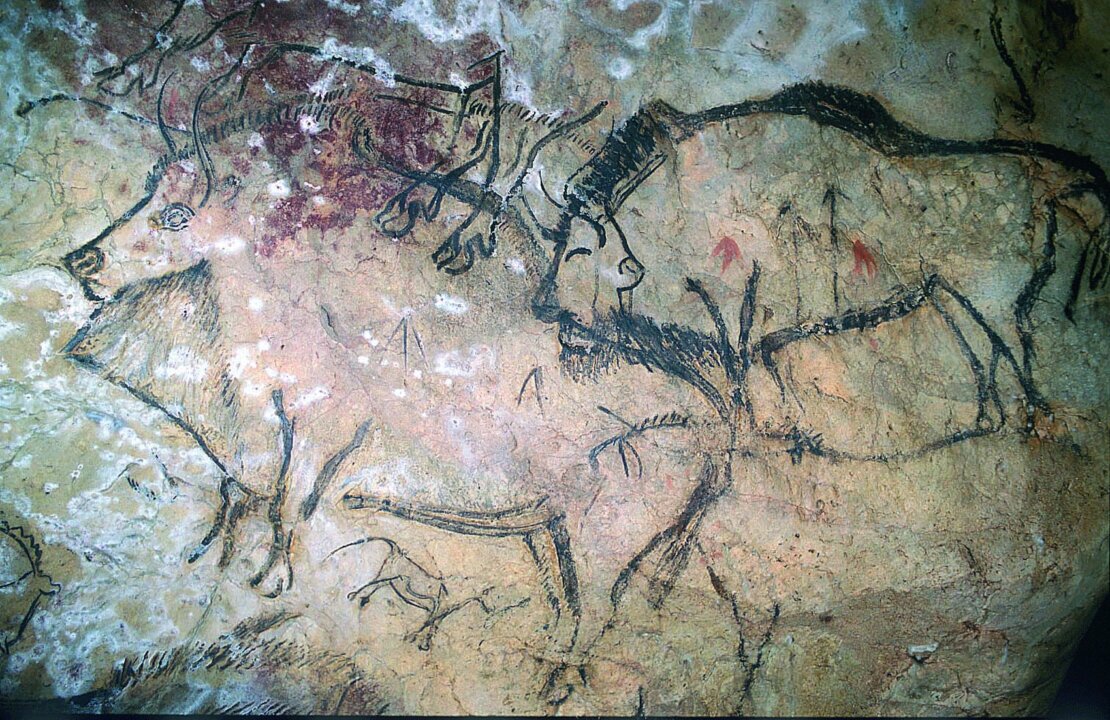
Two bisons inside the "Black Sittingroom" of Niaux Cave (Panel IV)
Crédit Photo: E. Demoulin / SESTA
The two bison are drawn in black colour. This means the black moon phase (also known as the new moon phase), the time of the monthly rebirth of the moon.
The winter solstice signs ⋀ and ↑ stand here for the southern moon standstill.
An extreme southern lunistice occurs about a black moon time in winter and is therefore difficult to observe. But the people of Niaux have apparently managed to capture this exact moment.
Due to an unfortunate coincidence or deliberately drawn like this, the bison on the right has two heads. One is looking forwards, the other backwards. This can again be interpreted as a depiction of the turning of the moon or as a representation of the change of the moon's shape, i.e. the new moon. The horns bring a little more clarity.
They are S-shaped, so they represent the waning and waxing moon together. This points to the black moon phase, when the image of the lunar horns reverses from the waning moon ⦅ to the waxing moon ⦆.
These two bisons are part of the larger pictorial panel IV in the "Black Salon" of the Niaux cave. The context provides even more insight.
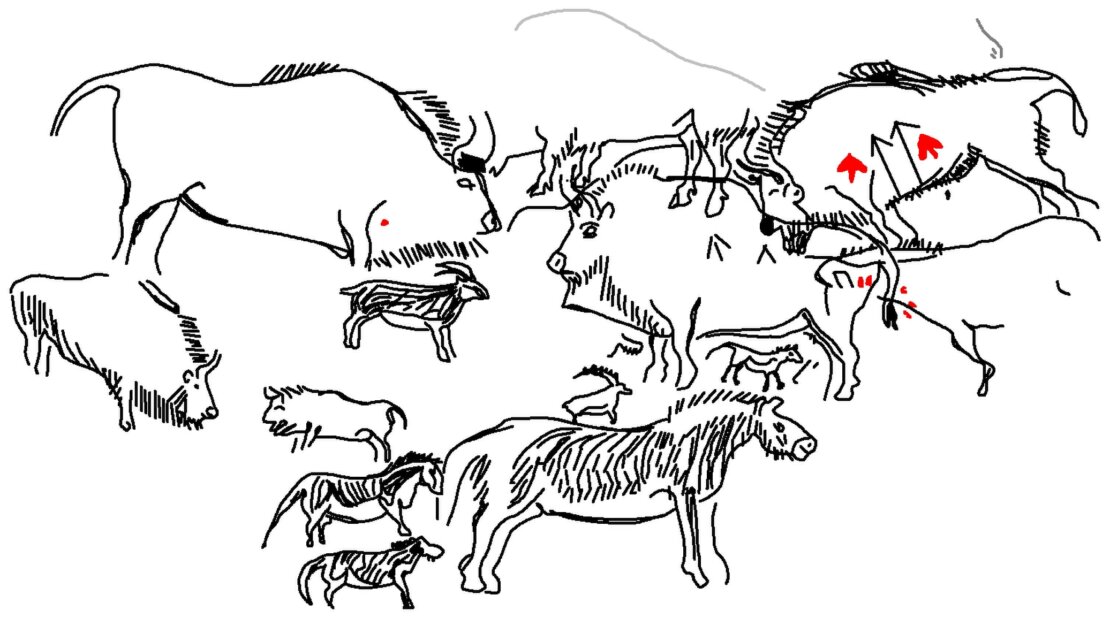
The complete panel of the bisons with arrow-shaped signs at the "Salon Noir" in Niaux cave. (Panel IV)
Drawing: H Ulrich
The bison with the two black lunistice-signs ↑ ⋀ has a very slender head and the horns of the waning moon. Opposite it there is a strong animal with the horns of the waxing moon. Taken together, this is again a sign of the new moon phase.
Below this large bison at the top left, you can see two smaller ones standing opposite each other. Their horns also show the change of the moon at new moon.
Two ibex indicate winter. Three small horses and a large one run to the right. A second large horse, but incomplete, is running to the left at the right edge of the panel. However, the solstice is not explicitly depicted.
This picture field is therefore about the astronomical event of an extreme southern moon standstill and the new moon; about the renewal of the moon at the time of winter solstice. This event was important in order to harmonise the lunar year and the solar year.